Friday, November 2, 2012

Otis's furniture

When I was growing up, I spent every Saturday night sleeping over at Genevieve's house. It was the same tiny house she and my grandfather built when they got married, a two-bedroom cottage of about 700 square feet (I'd be guessing) that they built for something like $2000 around 1940.

The table that we ate our meals at in that tiny house was a functional drop-leaf table that she positioned against a wall in between the couch and the back door. The space was so small that she almost never pulled up either side of the table, so I always thought it was just a small, rectangular table. She would occasionally tell me that my great-great-grandfather had "carved" the table (that was the word she used) from cherry trees in his yard. This always stuck with me, maybe because she so rarely spoke of her family.

The table that Otis carved from cherry trees on his farm and gave as a wedding gift to Ora and Clarence.

When Genevieve passed away, it was very important to her that certain things be passed down to me, her recipe box and that table among them. I was shocked to discover how well-crafted the table was, and to learn that there were several leaves that came with it; if they are all inserted, you could easily serve dinner for 12 around it.

It turns out that Otis (Genevieve's grandfather) was quite a master carpenter. He learned the trade from his father Sam (much more on him in the next post.) The table is actually one of three identical tables that Otis made -- he gave one to each of his daughters as their wedding gift. Genevieve ended up with Ora's table, and Corinne ended up with Edna's table. I now have both of those.

Otis Vaughn, carpenter extraodinaire

When Corinne passed away, she left a list of items in her house that she believed to be Vaughn heirlooms. I bought all of them from her estate to ensure they stayed in the family. So I am now the proud owner of several pieces of furniture that I can say with loving pride were handmade by my great-great-grandfather Otis: the two dining tables, eight chairs that he made to go with those dining tables, a nightstand or work table, and four rope-seat chairs that are incredible because the seats are made of tightly woven rope and have lasted incredibly well, considering they are probably about 130 years old.

The nightstand or work table (not sure which) that Otis made

The rope-seat chairs made by Otis. There are only three of them, which means he could have made them for Edna sometime after Corinne was born. Corinne was an only child and almost everything in her house came in sets of three instead of four.


Tuesday, October 30, 2012

Recipes: Potato-chip cookies

There's no attribution on this recipe card, but whoever invented these sounds like a genius to me.

Potato-chip cookies

Cream together 1 cup butter and 1/2 c. sugar till fluffy. Add one egg yolk. Cream again. Add 1 1/2 c. flour, 3/4 c. crushed potato chips and 1/2 c. of nuts. Drop from teaspoon, bake 12-15 minutes.

Potato-chip cookies, fondue'd

 UPDATE: I finally made these, and it turns out that they taste a lot like Scandinavian butter cookies, just a little potato chip-ier. A word to the wise: bake them in an oven that is no more than 350F; they burn easily. Not being a a fan of nuts, I omitted them and increased the potato chips to 1 c. (I also might recommend reducing the flour slightly) When they had cooled, I dipped each cookie in fondue chocolate to finish them off. They'd be good for a Christmas cookie sampler!

Saturday, October 20, 2012

Fannie and Otis

Okay, so you've met my grandma Genevieve, Genevieve's mother Ora, and Ora's two sisters Edna and Hattie. And you know I am lucky to have lots of photos and clippings of all of these people thanks to a treasure trove of family history that I believe Edna compiled in the 1930s, and I believe she was inspired to do so after the death of her mother. So the collection that inspired this blog, that inspired me to learn about my family in the first place, that inspired this passionate new hobby that has consumed my life for the past year, began as a loving memorial to Ora, Edna and Hattie's parents: Fannie and Otis Vaughn.

Portraits of Otis and Fannie Vaughn, painted from photographs in my collection

So who were Fannie and Otis Vaughn?

Well, let's start with Fannie. Frances Ann Vaughn was born on April 11, 1847 in Lincolnshire, England. She was named after her grandmother, Frances Brittain, and she was the third of five children born to William and Elizabeth Sutton (Betsey) Brittain. She had a brother named John and a sister named Hannah (both of whom were older) and two younger brothers: William and Samuel. Around 1855, when her youngest brother was only about a year old, and Fannie herself was only 8, the family moved from England to Wisconsin, and they settled in Honey Creek, just a few miles away from Spring Prairie.

Fannie as a young woman

As I continue to go through the stories of my family, I am alternately awed by and in disbelief of a family's willingness to sell everything they owned except for what they could carry, and board a ship for a journey of several weeks across an ocean with very young children, only to face a long overland journey or a smaller boat trip to end up in the middle of the United States, a place they had never seen even in photographs before. It speaks to the quality of their character, and their sense of hopelessness in their home country. And I can't help but think, every time I read about a journey like this, that they must have had no idea exactly what they were getting into.

So, in the case of Fannie's family, why Wisconsin? Well, they came here because Fannie's uncle, Samuel Brittain, had come to America 20 years earlier, in 1834. After living in upstate New York, then Michigan (with short stops in Chicago and Milwaukee as well,) he finally landed in Walworth County in about 1837-1838. He was one of the earliest settlers of the county, which was only settled by white men for the first time in 1836 (more on that later.) He established a farm of 80 acres in Honey Creek and stayed there all his life. Two years later in 1839, his brother M.R. moved to Honey Creek as well. In 1855, their brother William brought his family, including Fannie, and so the Brittain family of Pinchbeck, Lincolnshire, England was fully transplanted to Honey Creek, Wisconsin, it seems. (Though I'm having trouble finding records, so it's possible they had other siblings in England who did not emigrate and I just haven't found them yet.)

At the same time that Fannie's uncle Samuel was settling in Honey Creek, Otis Vaughn's parents, Samuel C. Vaughn and Sarah H.M. Vose Vaughn, were establishing a farmstead in the fledgling village of Spring Prairie just a mile or two away. They came in the spring of 1837 with three children and had two more once they had moved here; Otis, the youngest, was born on March 29, 1841 in Spring Prairie. (One of the five children, a girl named Abbie, would die as a teenager. Lots more on Sam and Sarah, and Otis's early life, to come in a later post.)

Otis as a young man

Though I don't know exactly how Otis and Fannie met, it's safe to assume that since it was such a small community and they lived just a few miles from one another that Otis knew Fannie's uncles and probably met Fannie shortly after her arrival in the county. On December 6, 1864, when Fannie was just 17 years old, Otis Vaughn and Fannie Brittain were married in Spring Prairie. (The date is striking to me for taking place during the Civil War. There is a family rumor that Otis took advantage of the fact that you could pay someone to take your place in the Union army, probably because his aging father had already turned over most of the farming duties to Otis, and to lose the de facto head of the farmstead would have been a great hardship on the family.) Otis's father died just a few years later in 1868, leaving farmstead to Otis and Fannie. Otis's mother Sarah continued to live with them as well.

Otis and Fannie's wedding portrait, difficult to scan because of the daguerrotype case it's in

Otis and Fannie had their first child in 1870, a daughter they named Julia Augusta, but sadly she survived less than a year. (Her early death is a reminder of the tragic toll childhood diseases used to take on families in the days before vaccines were available.) In 1873, Hattie was born. Edna came in 1877 and Ora in 1884; there was an 11-year age difference between Hattie and Ora.

The scrapbook is overflowing with tales of Otis and Fannie's life, so much so that I feel like I know them. The picture of their life together that is painted by these news items is that of a very full life, one full of social events, community service, travel, close friendships and love and responsibility for family near and far.

Fannie, in the photo the portrait is drawn from


Here are some of the news items:

"MARRIED: At Burlington, December 6th, 1864, by Rev. S.H. Batteau, Mr. Otis E. Vaughn, of Spring Prairie, and Miss Fannie Brittain, of Honey Creek."

"(Date unknown): The ice cream social on the lawn of Otis Vaughn Wednesday evening was largely attended. The Young Ladies' Guild netted a good sum from the sale of cream."

"(Date unknown): Otis Vaughn, of this city; G.A.Palmer, of Vienna; and E.F. Buttles, of Waterford, are the jurors from this neighborhood who will serve for the May term of the United States circuit court in Milwaukee."

"(Date unknown) From the Elkhorn Blade: Otis Vaughn and family, of Burlington, Peter Howard and wife and L.G. Latham and wife (Otis's sister Delia - Ed.), journeyed northward on Saturday afternoon until they came to Idlewild at Lake Lauderdale, where a week will be spent in pleasure and resting. 'Dad' will keep the larder well supplied with fish."

 "(Date unknown) Mr. Otis Vaughn finds his family increased by one -- a very small one."

"(Date unknown, but sometime between 1877 and 1884) Mr. O.E. Vaughn of Spring Prairie, accompanied by his wife and two daughters (Ora wasn't born yet - Ed.), Mrs. Chas. Loomis, of this place (Fannie's sister Hannah), and Miss Noble, of Rochester, took their departure yesterday forenoon for Jewell County, Kansas, where they will remain three or four weeks, visiting friends and relatives. They go via. Freeport and Rock Island, and will arrive at their destination this afternoon. We wish them a pleasant journey and a safe return." (The relatives they are going to visit here are Fannie's brother William and his family, who had moved to Kansas after the Civil War.)

Fannie a little later in life

"(Date unknown) O.E. Vaughn has been repairing his barn, house and other buildings this summer, not having anything else to do, and he now has them fixed up in good shape. He thinks he would not like a job of tearing off plastering that lasted the year round."

"1884: Mr. and Mrs. O.E. Vaughn of Spring Prairie, celebrated the twentieth anniversary of their wedding, or China wedding, on Monday evening of last week, which proved a very enjoyable occasion from first to last. There was a very large attendance of friends, and neighbors, and a few from this village, and the bride and groom of twenty years ago were made the recipients of many fine presents of China ware."

"(Date unknown) Mr. and Mrs. Otis Vaughn, of Spring Prairie, returned to this village over the Central Railway last Wednesday morning after an extended trip to Canada and the East, having been absent two weeks. They visited relatives near Toronto, Canada, and attended an agricultural Fair at Toronto, which Mr. Vaughn says, compares very favorably with our fairs. He says the horses on exhibition were the finest he ever saw. The people are slow, but exceedingly polite. They stopped at Niagara Falls long enough to view the wonderful scenery of this gigantic cataract."

"(Date unknown) Mrs. Otis Vaughn and little daughter of Spring Prairie visited relatives and friends in Elkhorn last week."

"(Date unknown) Otis Vaughn and Main Hubbard filled their ice houses early last week and just in time too, it seems."

"(Date unknown) O.E. Vaughn has sold his trotting horse, "Black Prince."

"(Date unknown) Mr. O.E. Vaughn of Spring Prairie exchanged greetings with the [Elkhorn] Independent on Friday last."

"(Date unknown) Mr. Otis Vaughn and family, of Spring Prairie, moved into the village yesterday and today will make Burlington their permanent home. They now occupy the P.H. Cunningham house on the East side of the Fox River, but early next spring, Mr. Vaughn will build a fine residence on his lots on the corner of Washington and Dyer streets, at the rear of the Opera House.
   We welcome Mr. Vaughn and family as citizens of Burlington and hope their home in our midst may be pleasant and long continued."

"1888: Mr. Otis Vaughn is hauling stone for the foundation of his new residence to be built early next spring on his fine corner lot at the rear of the Opera House, opposite the old 'Sawyer property' on Washington and Dyer streets."

"1889:  Mr. Otis Vaughn and family moved into their new house on the corner of Washington and Dyer streets last week, and will soon be comfortably settled in their fine, cozy home."

"(Date unknown) Mr. Otis Vaughn is making wagons in the shop formerly occupied by Geo. Stohr, deceased. Mr. Vaughn is a thorough mechanic."

"(Date unknown) Mrs. Harriman and Mrs. Latham, of Elkhorn, made their brother, Mr. Otis Vaughn and family in this village, a pleasant visit last Friday, returning to the quiet village of Elkhorn in the evening after a days' pleasure viewing the sights of this bustling city. They thought our new Court House and electric lights were very fine. They don't see such modern improvements in the smaller villages."

Fannie in later years

"(Date unknown) About sixty were present at a progressive euchre party given by Mr. and Mrs. Joe Vaughn (Otis's first cousin and his wife - Ed.) Tuesday evening. Mr. Chas. Peck and Mrs. Hettie Hicks carried off head prizes, and the booby prizes were won by Herman Harris and Mrs. Otis Vaughn. All reported a very pleasant time."

Fannie and Otis and a dog

"(Date unknown) Mr. and Mrs. Otis Vaughn visited relatives in Elkhorn last Wednesday evening and a portion of Thursday, returning to their home in this village last Thursday afternoon."

"(Date unknown) Otis Vaughn and family visited at W. Merrick's Sunday."

"(Date unknown) Otis Vaughn is in Milwaukee this week doing duty as a juror in the U.S. District Court."

"1905: There isn't a happier man in town than Otis Vaughn. the cause of it is that he wears the title of grandpa since Saturday, Jan. 7, 1905, when a bright baby girl arrived at the home of Mr. and Mrs. J.J. Cheeseman (Hattie - Ed.) in Chicago."

"1917: A little son was born to Mr. and Mrs. Clarence Potter (Ora - Ed.) at their home in the town of LaFayette on Friday, Dec. 28th, 1917. It is needless to say that Grandpa and Grandma Vaughn are pleased over their first grandson."

Fannie (second row, far right) and Otis (third row, third from right I believe) pose with several other people in 1917, at the celebration of the 50th wedding anniversary of William W. (Billy) Vaughn and his wife Mary Clark Vaughn.

"1921: Otis Vaughn has received notice of the death of his brother Benjamin's widow, Martha Vaughn, at the home of her daughter, Mrs. Olive Berry, at Stockton, Calif., on November 29, 1921. She was born July 4, 1838, and was a sister of Sumner Vaughn, of Honey Creek. The family formerly lived at Spring Prairie, moving to Minnesota and later to the Pacific Coast. Her ashes were buried beside those of her husband at Yakima, Wash." (Lots more Otis's siblings and the confounding relationship between Ben and Martha Vaughn to come in a later post.)

Otis passed away in 1923. This court notice appears shortly thereafter: "Waller & Ruzicka, Attorneys, County Court, Racine County, In probate: In the matter of the last will of Otis E. Vaughn, deceased. Notice is hereby given, that at a special term of the country court to be held in and for the said county at the court house in the city of Racine in said county on the third Tuesday, being the 15th day of January, A.D. 1924, at the opening of court on that day the following matter will be heard and considered: The application of Fannie A. Vaughn, executrix of the will of Otis E. Vaughn deceased, late of Burlington in said county for the examination and allowance of her final account, and for the assignment of the residue of the estate of said deceased to such persons as are by law entitled thereto; and that the court find and determine whom the real estate owned by said deceased vested upon the death of said deceased, and for the determination and adjudication of the inheritance tax if any, payable in said estate. Dated December 18, A.D. 1923, By the court: Walter C. Palmer, County Judge."

Fannie as a widow, in front of the house at 602 Lewis St. in Burlington

Three years later, Fannie's sister Hannah died. "1926: Funeral services were held at the home of Mrs. Otis Vaughn on Lewis St. last Friday afternoon for Mrs. Charles Loomis, one of the well known matrons of this vicinity, who died the previous Wednesday, July 21, at the home of her daughter, Mrs. S.W. Hollister, at Oshkosh.
   Hannah Brittain was born in Lincolnshire, England, July 16, 1843. When a girl she came to America with her parents who settled near Honey Creek. In 1865 she was united in marriage with Mr. Loomis, and they settled on a farm south of the city where they lived until twenty-five years ago when they moved into Burlington. Mr. Loomis died in 1913 and for the past few years, Mrs. Loomis has spent the winters with her daughter, Mrs. S.W. Hollister*, at Oshkosh. One sister, Mrs. Otis Vaughn, and one brother, John Brittain, of Wasco, Calif., besides the daughter survive. Also one grandchild, Miss Edith Hollister."

Fannie died in 1931. Presumably her daughter Hattie was still living with her in the house in Burlington after moving back due to the untimely death of Hattie's husband in 1918. Fannie and Otis are both buried in the Hickory Grove Cemetery in Spring Prairie.

Long after they were gone, Otis and Fannie occupied a place of high esteem in the hearts of their family. In her letters, Corinne often spoke fondly of "Grandma and Grandpa Vaughn," -- it was clear that even in her 90s, she still felt the sun rose and set by them. And it was because of Corinne's annual summer trips to Burlington to visit Otis and Fannie that she and Genevieve were as close as they were.

Of all of the ancestors I have had the good fortune to "meet" through the process of researching my family history in Walworth County, Otis and Fannie are the ones I feel most connected to, and the most compelled by. They lived during such a pivotal part of Wisconsin history; Otis was born here seven years before Wisconsin was even admitted to the United States. (It was the 30th state to be admitted.) They watched Wisconsin develop from infancy through the Progressive era of the 1920s. Their lives were typical of the lives being lived all over the state -- small farming giving way to life in small cities as the state became more urbanized toward the end of the 19th century. They were members of the generation that transitioned Wisconsin from wilderness to organized community.

Their lives undoubtedly involved a lot of hard work, but they also seem to have taken much pleasure from their rich friendships within their extended families and their close-knit farm community. They appear to have lived full, rich lives and had a great effect on everyone who knew them. And really, what more could any of us hope for from our lives?

*An interesting sidenote: When she was a child, Hannah Brittain Loomis' daughter Lottie (the Mrs. S.W. Hollister mentioned here) looked eerily like me as a child. More to come on that in a future post.

Update (2/16/14): I have tracked down more records from Lincolnshire and I now know that Samuel, William and Deacon Brittain were actually the three youngest of the Brittain family of Pinchbeck, Lincolnshire. They had five older siblings: Richard, John, Thomas Caswell, Robert and Mary, all of whom presumably remained in England. Their parents, John Brittain and Frances Caswell (or Casswell) were married on 11/25/1802 in Horbling, Lincolnshire.


Sunday, September 30, 2012

Recipes: Stay-a-bed Stew

In a world without electric slow-cookers, without microwaves or instant meals, where every meal required a lot of effort, feeding yourself (and your family) when you were sick was a challenge. Genevieve's recipe box solves the problem with this beef stew, which could probably sit on a low burner on the stove all day if necessary (after the initial baking.) Something delicious to try even if you're not sick.

Stay-a-bed Stew


2 lbs. beef stew cut as desired
1 pkg. frozen peas
1 cup sliced carrots
2 chopped onions
1 tsp. salt & pepper (cut down on pepper)
1 can tomato soup thinned with 1/2 can of water (mushroom soup may be substituted)
2 raw potatoes sliced
Crushed bay leaf.

Cover tightly and bake in oven at 275 degrees for 5 hours.

Genevieve's note: (I put in more carrots and potatoes. Also have used frozen green beans instead of frozen peas.)


Friday, August 31, 2012

Recipes: Edna's Chocolate Cookies Icebox Cake

Another recipe of Edna's (I believe.) She seems to have been a big fan of icebox tortes. They were probably appealing in that they were fairly simple to make and could be prepared a day ahead, leaving more time on the day of a party or event to make all of the other complicated, labor-intensive recipes that dominated in the days before "modern conveniences."

Chocolate Cookie Icebox Cake

36 oblong chocolate cookies*
4 eggs
1 c. sugar
1 package of whipped cream
1 pkg. Knox gelatin

Dissolve gelatin in 1/3c. cold water for 10 mins. Add 1/3c. hot water. Beat eggs until light, add sugar and beat, then whipped cream and cool gelatin. Arrange layer of cookies in pan - spread with mixture, then another layer of cookies and mixture, finishing with cookies. Serve with whipped cream. Serves 12 people.

*Not quite sure what "chocolate oblong cookies" refer to. Possibly those inexpensive chocolate sandwich cookies that come prepackaged at the grocery store?

Tuesday, August 28, 2012

Recipes: Edna's Farina Torte

Another recipe from Edna, this time for something called a "Farina Torte." I had to look up what Farina is. Here's what Wikipedia has to say:

"Farina is a cereal food, frequently described as mild-tasting, usually served warm, made from cereal grains. In contemporary American English use, the word usually refers to Cream of Wheat brand cereal made from soft wheat. Wheat farina is a carbohydrate-rich food, often cooked in boiling water and served warm for breakfast, or cooked with milk and made into semolina pudding. It is used as an ingredient in many dishes and in processed foods such as breakfast cereals and pasta."

So it seems in this case, Farina refers to Cream of Wheat cereal. Interesting fact also learned from Wikipedia: You know the powder-y crumbs that are often found on the outsides of English muffins? That is farina, which is used to keep the muffins from sticking to the baking tins.

Edna's Farina Torte

(2/3c. bread crumbs - 1/2 c. Farina) sifted together
1 1/2 tsps. B.P.*
1/2 c. nuts
6 egg yolks
1c. sugar
6 egg whites

Beat egg yolks well, gradually beat in sugar and then bread crumbs + Farina and B.P. Add nuts and lastly fold in beaten egg whites. Bake in 1 or 2 largers (? Could not read handwriting - Ed.) and serve with whipped cream.

*I assume this means baking powder.

Sunday, August 26, 2012

Hattie Vaughn Cheeseman

I have lots more recipes of Edna's to post, but I've started to feel guilty that poor Hattie hasn't gotten an entry yet.

As you know, my grandmother's mother (Ora) was one of three sisters born to Otis Vaughn and Fannie Brittain Vaughn on the family farm in Spring Prairie, Wis. And it's tempting to call Hattie (Harriet) the oldest, although technically, there was a baby born before her. Julia Vaughn was born in 1870, but died in 1871. There's a heartbreaking photo in the collection with what must be Fannie's handwriting on the back that just says, "Julia August Vaughn. Our first little girl, born April 25, 1870."

First-born daughter Julia would only live about a year.
Hattie was born in 1873. Fannie was 26 when she was born and Otis was 32. There are quite a few photos of Hattie, possibly due to the fact that she was the first-born to survive.

Ora (left), Edna and Hattie (right) at Loomis farm; the caption on the back of the photo says, "Lottie [Loomis] took this at Aunt Hannah [Loomis]'s farm home, 1898)

Hattie is also probably the best-represented sister in the clippings in the scrapbook. It begins when she is just a child, when she has a starring in this dramatic piece of "news" printed by a local paper:

"Mr. Otis Vaughn and wife of Spring Prairie had a remarkable escape from what might have been serious and fatal.
     The facts as we learn them from Mrs. Silas Patten are as follows: Mr. and Mrs. Vaughn were returning home after passing a portion of the early evening at the residence of Mr. William Hubbard. In passing the house of Vernon Raleigh and turning the corner, Mr. V. turned himself to look and see if any one was at home or lights to be seen, when the horse started rather suddenly, instantly throwing Mr. Vaughn to the ground, becoming insensible and unable to move; the line and the robes went with him. In this dilemma, Mrs. Vaughn considered what was best to be done; both children were on the seat beside her. Failing to stop the horse by repeated cries of, "Who," she took the youngest child [Edna, in this case -Ed.] under her arm and jumped, fortunately clear of the wheels and safe. The horse continued to run with the other child [Hattie - Ed.]. Mrs. Vaughn hesitated between going back to see her husband or to go forward and try and rescue the other child.
    As soon as possible, she made an alarm and roused the people at Mr. William Vaughn's, where was a party. Instantly parties came out and learning the facts, Mr. Allan Cocroft started upon a run, and as the horse was rising another hill slackened somewhat his speed, when Mr. C. caught the rear of the buggy, drew himself up under by the reach, grasped the reins, and then called to the horse to stop, which in a moment he obeyed. The horse was not frightened but loose and of course was on his way home.
    Getting into the buggy, Miss Hattie, 6 to 7 years of age, said to Mr. Cocroft that she kept calling Who, Who, Who, to Billy, and who can say that the animal was not quieted by the child's voice. She told her mother afterwards that she tried to get out but the wheels turned so fast she could not, she got back in again. Mr. Vaughn was immediately cared for. It was found he had cut several places in his head, beside bruises, &c. He fainted after being taken into the house, but gradually recovered. Altogether it was a most fortunate escape."

(I think the most incredible part of that story is the part where Allan Cocroft runs fast enough to catch a runaway horse, then pulls himself onto a moving carriage and climbs forward enough to grab the reins and stop the horse. Action movies have nothing on these early pioneers.)

Hattie, around the age she would have been when she survived the harrowing runaway carriage incident

Other mentions of Hattie in the clippings:

Miss Hattie Vaughn remained over Sunday with friends at Elkhorn.
Misses Hattie Vaughn and Leta Holmes are attending school at Burlington.
Miss Rispah Harriman spent Thursday with Hattie Vaughn.


Hattie, front left, and Jack Cheeseman, back right, pose for a photo with Ora and Clarence

In October of 1903, this marriage announcement appears in the Burlington paper:
     "The marriage of Miss Harriet Vaughn and John J. Cheeseman, of Chicago, took place last Wednesday at 12:30 p.m., at the home of the bride's parents, Mr. and Mrs. Otis Vaughn, in the town of Spring Prairie. The ceremony was performed by Rev. P.H. Linley, rector of St. John's Episcopal Church of Elkhorn, in the presence of only the immediate relatives and a few intimate friends. The house was very prettily decorated  with fall flowers and autumn leaves. An elaborate wedding dinner was partaken of by those present, after which Mr. Cheeseman and bride departed on a two weeks wedding trip to the east, after which they will make Chicago their home, where the groom has a desirable situation. The bride is well-known in this city, where she made her home for a number of years and was also a teacher in the public schools. She has a wide circle of friends who will extend their best wishes for a happy future."

Another announcement from Elkhorn, dated Oct. 7, 1903:
     "The marriage of Miss Harriet Vaughn and John J. Cheeseman of Chicago was solemnized yesterday afternoon at the home of the bride's parents, Mr. and Mrs. Otis Vaughn at Spring Prairie. The ceremony was performed at 12:30p.m. by Rev. P.H. Linley of St. John's Episcopal Church of this city, in the presence of relatives and a few intimate friends. The house was very beautifully decorated with autumn leaves and flowers. The wedding march was played by Mrs. W.H. Brigham of Chicago.
    The bride is a sister of Miss Edna Vaughn of this city, and was a teacher in the schools here three years ago. She has many Elkhorn friends who will extend their best wishes for a happy future. Mr. and Mrs. Cheeseman departed for a two weeks' trip through the east, after which they will live in Chicago, where the groom has a good position."

(This means that Hattie was 30 years old when she got married. We have this nostalgic idea that everyone got married so young back then, but over and over again, my family seems to have bucked that tradition.)

Two years later, Hattie is mentioned in Edna's wedding announcement; "Owing to the continued and dangerous illness of the bride's sister Mrs. Cheeseman..." so it appears that not long after being married, she developed some sort of dangerous illness, though I suspect it may have been related to the birth of her first child, a daughter named Loraine, in January of that year (1905). She must have recovered, because she had a second daughter (Harriet) on August 21, 1909.

Then nine years later, in 1918, her husband (known by the family as "Uncle Jack") died suddenly and unexpectedly of the horrible Spanish flu pandemic. His obituary, dated December 17, 1918, reads:

"Friends of the family here were shocked on Tuesday to hear the news of the death at his home, 775 Pennsylvania Ave., Milwaukee, of John J. Cheeseman, a son-in-law of Mr. and Mrs. Otis E. Vaughn of this city. Mr. Cheeseman's death was due to pneumonia, which followed an attack of influenza he contracted the previous Friday. The remains will be brought here over the interurban* on Friday afternoon at 2 o'clock for interment in the city cemetery, short services being held at the grave.
    Mr. Cheeseman was born in England in November, 1867. He came to this country at an early age and was living in Chicago when he was married to Harriet A. Vaughn in October 1903. They moved to Milwaukee four years ago, where Mr. Cheeseman was holding the position of traffic manager for the Cudahy Rubber Co. at the time of his death. He is survived by a wife, two daughters, Loraine and Harriet, and two sisters."

After his death, Hattie moved with her two children, then 9 and 13, back to Burlington where they lived with her parents. My grandmother Genevieve was just 8 at the time, and since she lived on the Potter family farm in nearby Elkhorn, I believe she saw her cousins Loraine and Harriet fairly frequently.  (Corrine would have just missed them -- her family moved up to Manitowoc right around the same time, though she remembered spending time with them on her trips to visit "Grandma and Grandpa Vaughn" in the summers.)

Hattie lived to 1950, dying one day shy of her 77th birthday.

As I type up the condensed life stories of these people I didn't really know, I am repeatedly struck by the truism that no one's life is easy. Hattie was a survivor; first she survived infancy (when her older sister Julia had not), then she survived a harrowing runaway carriage incident, then a "dangerous illness" probably related to giving birth, then the Spanish flu and the death of her husband.

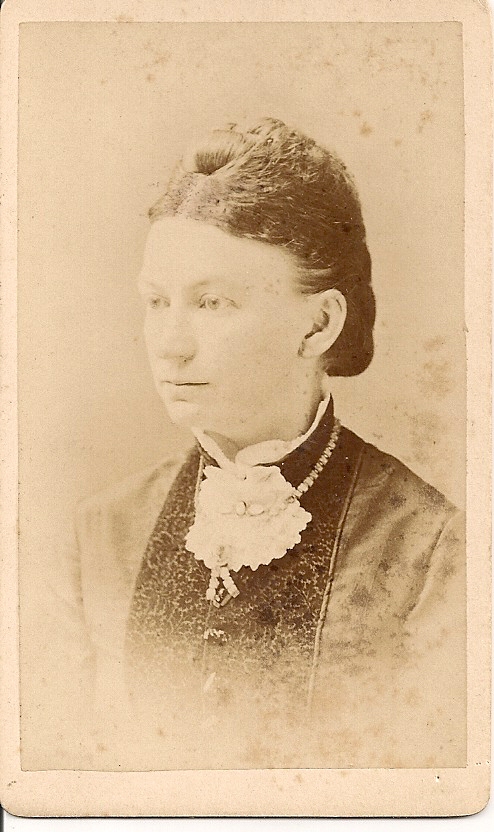
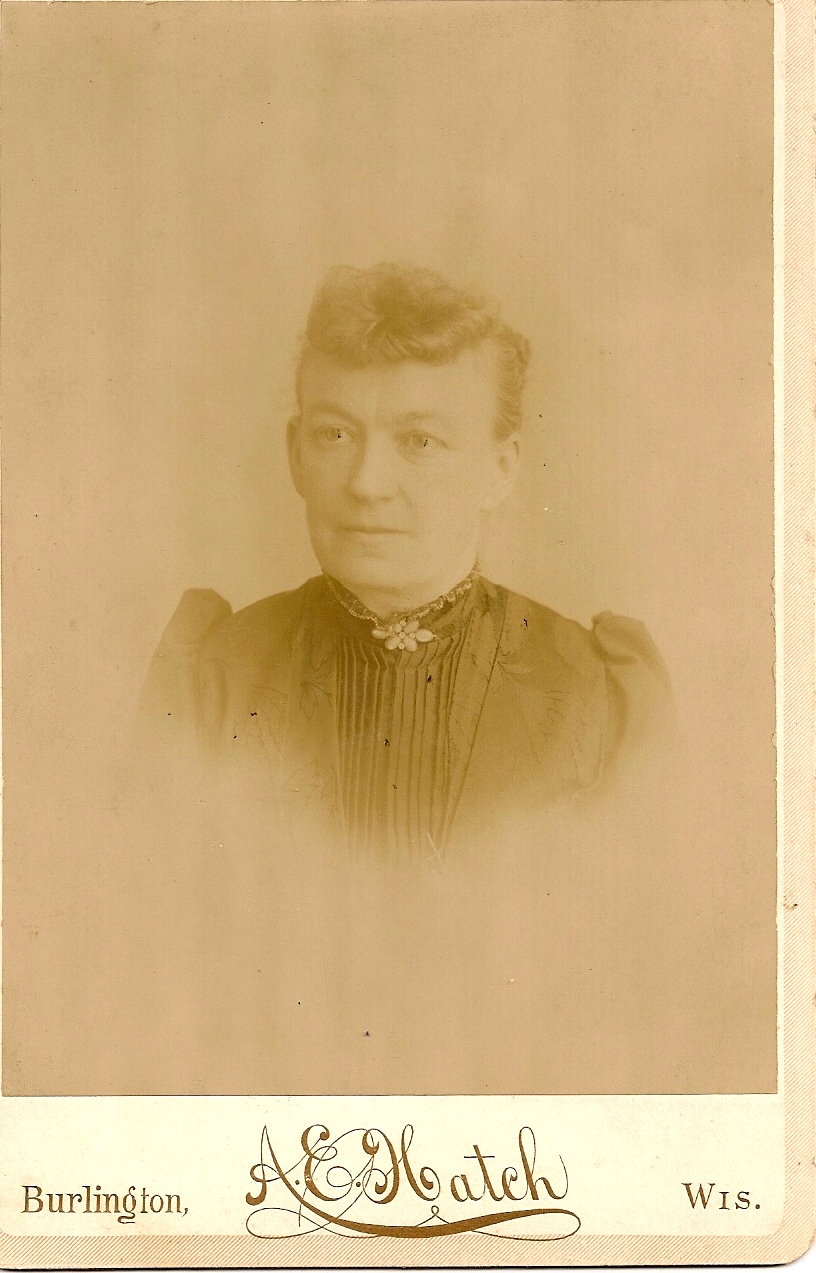
The human ability to rise above tragedy and heartache is never more clearly on display than in the stories of those who came before us, and who persevered and made an enviable, beautiful, complicated whole out of the sum of the parts of their lives, many of which were devastating. You can see it in their faces as they age; graceful, determined, steely, human.

Hattie as a baby


Hattie, age 3 or so?


Perhaps a year or two later

Hattie, right, and possibly Ora? I can't quite tell. Hattie looks to be 12 or 13?

Hattie at high school graduation?

This looks to me like a school photo from her teaching days, though I can't be sure.

*Interurban railways were electric railroads that connected urban centers in the first part of the 20th century. From an article I wrote about them for At the Lake Magazine:


"The words “light rail” or “commuter rail” are a fixture of modern politics these days, but most people don’t realize that a century ago, the communities of southeastern Wisconsin were leaders in the burgeoning light rail service.  At that time, the mostly passenger service lines were called interurban railways, or “interurbans” and they were designed to provide residents in outlying rural areas with access to nearby urban communities. Interurbans proliferated in Midwestern states from Ohio to Wisconsin, where greater distances between cities and poor road quality made carriage travel slow, difficult and unpredictable.

Around 1900, as electricity became more widespread, the Milwaukee Electric Railway and Light Company (TMER&L for short), under the direction of John I. Beggs, began plans for an ambitious interurban railway plan for southeastern Wisconsin, one of the most ambitious in the country at that time. Though the plan was never fully realized, track was laid from Milwaukee as far south as East Troy... Residents could now make a trip into Milwaukee in about an hour-and-a-half; a considerable improvement over horse-drawn carriage.