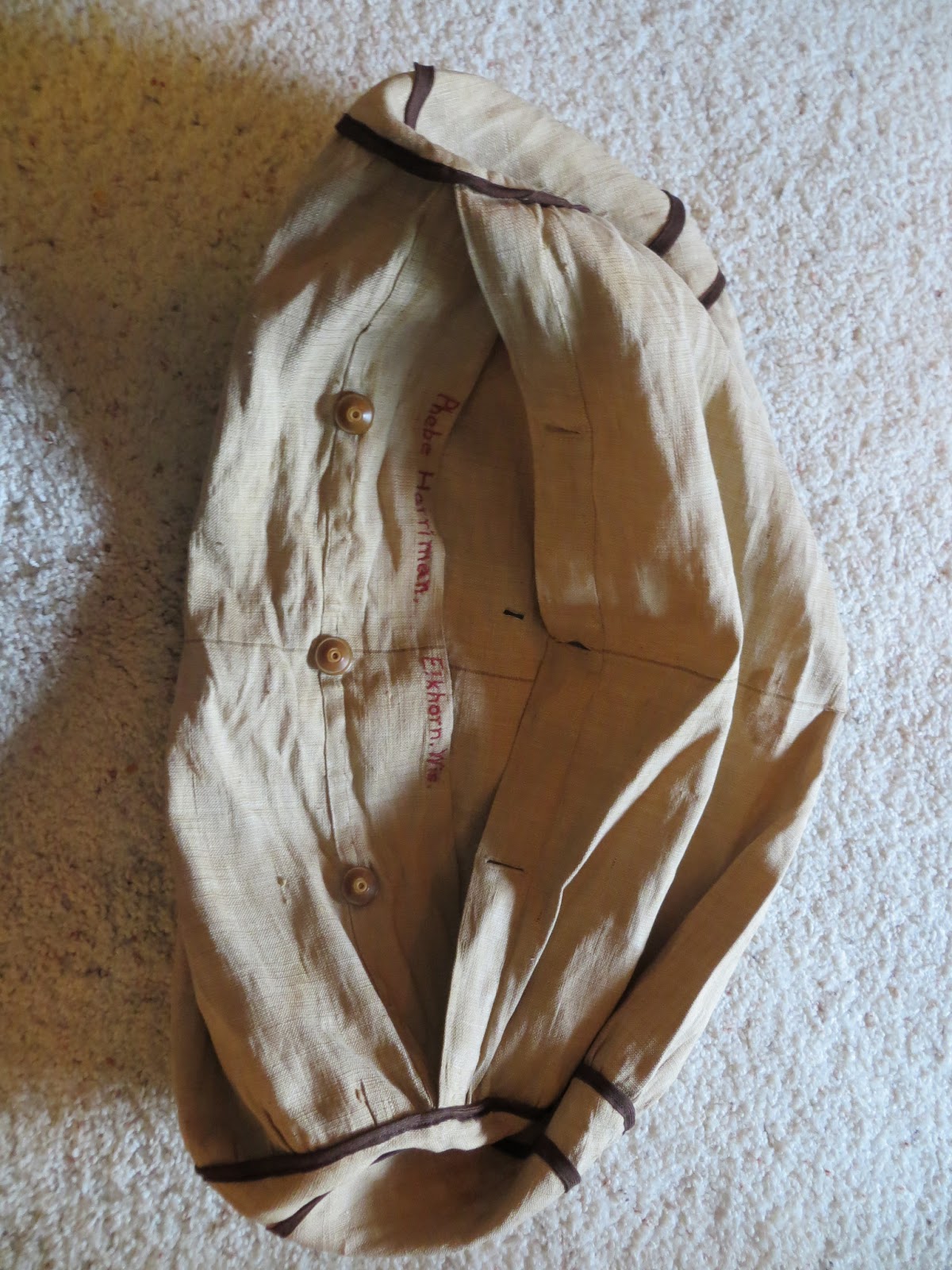
Speaking of my great-great-aunt Phebe, this is a mystery that has been driving me crazy:
I inherited a burlap... something... that used to belong to her. It has her name embroidered on the seam along with "Elkhorn, Wis." -- the town she called home from 1876 until her death. The mystery item is about two feet in length and sort of half-oval or crescent shaped. It has a row of buttons across the top like you'd find on a duvet cover. But what is it?
Several people have suggested a cover for a bolster pillow. This may turn out to be the case, but that makes me wonder why she embroidered her name and city on the pillow?
Other suggestions have included: old-fashioned nursing pillow and hot water bottle holder. (The size of it makes me doubt it was a hot water bottle holder, unless they had the world's largest hot water bottle. Nursing pillow was an interesting suggestion, but Phebe only had one child, and they didn't move to Elkhorn until that child was four years old.)
So I need your help: does anyone know what this is? Is it in fact an unstuffed bolster pillow? Or is it something once essential that we no longer recognize?
My family were some of the original settlers of Walworth County, Wis. Join me as I delve into their history, complete with vintage photos, journals, letters, recipes, joys and struggles.
Saturday, June 15, 2013
Monday, May 27, 2013
Memorial Day stories: Stewart Sizemore and the Korean War
This Memorial Day, I'm taking a break from writing about my own family's history to tell the story of one incredible veteran I had the good fortune to interview in 2006 when I worked for a local Walworth County newspaper. Stew Sizemore has one of the most incredible life stories I've ever heard. His stories from the Korean War awakened in me a fascination with that war and its sad mismanagement that is still very strong in me today. Stew is also one of the kindest and warmest people I have met. Below is the story I wrote about him in 2006, when he was included in a Wisconsin Public Television documentary about the Korean War.
![]() |
| Lake Geneva veteran Stewart Sizemore poses with the medals he received as a result of his service in the US Army during the Korean War. |
Lake Geneva veteran featured in Korean War documentary
Orig. published 11/03/06 in The Beacon (Walworth County)
“It
was the bloodiest battle I ever saw,” remembers Lake Geneva resident Stewart
Sizemore of the Battle of Taejon, fought in July 1950. It was one of the first
major battles of the Korean War and Sizemore, a 17-year-old infantryman, was
there.
More
than 56 years later, the memories haunt him. “When we went out to Korea, we had
138 men in our company. I wandered around behind enemy lines for five days
after Taejon … dodging North Korean patrols. I had a BAR (Browning Automatic
Rifle) with one round left in it. When I came out in an apple orchard five days
later, we had 12 men left in the company.”
The
Korean War, long known as “The Forgotten War” for its relative lack of exposure
with the American public, produced thousands of similarly horrific stories.
Many of these stories have never been told. As the veterans of the Korean War
age, these “forgotten” stories are being lost forever.
Wisconsin
Public Television, in association with the Wisconsin Historical Society,
recently undertook a project to document the stories of Wisconsin residents in
the Korean War. They have produced a two-part documentary entitled Wisconsin
Korean War Stories.
Sizemore
was one of 52 veterans interviewed for the program.
Producer
Mik Derks (Wisconsin World War II Stories) amassed a wide range of
interviews for the documentary, selecting veterans from different branches of
the service and all areas of the state. Due to the nature of the Korean War,
most of the interviews that made the final cut of the documentary were told by
soldiers who fought in the ground war. “Most of (the Korean War) was the ground
war,” said Derks, “so we focused on the Marines and the Army who were right
there slugging it out.”
The
project began three years ago after the success of the Wisconsin World War
II Stories series. Derks felt it was vital to collect the stories of Korean
War veterans. “They really do feel forgotten,” he said. “People just didn’t pay
much attention to (the war) and the longer it went on, the less they seemed to
care about it.”
Sizemore
agreed to be interviewed by Derks because of that feeling of invisibility. “I
got so sick of watching the news and they would mention WWII and they would
mention Vietnam, they mention Afghanistan, but they don’t mention the Korean
War.”
Sizemore’s
story is an amazing tale of survival. Born in rural Appalachian West Virginia,
his mother gave birth to three sets of twins during the Great Depression.
Unable to feed them, she sent them to live in an orphanage. When Sizemore was 5
years old, he and his siblings were adopted out as farm labor to a rural farm.
“It was basically slave labor,” Sizemore said. “We got one pair of shoes a
year, and we walked seven miles to school and seven miles back again every
day.”
To
escape a life of back-breaking labor, Sizemore ran away as a teenager and
adopted a hobo life, riding the rails and living in hobo jungles around the
country. When he was 16, he and a friend were hopping a freight train in
southern Illinois on a rainy night. Sizemore caught the train, but his friend
slipped and fell, and was pummeled under the wheels of the train. “They carried
him out of there in a bushel basket,” he said. “And I decided right then I was
joining the service.”
When
the Korean war broke out on June 25, 1950, Sizemore was stationed in Japan. His
unit shipped out to Korea on the Fourth of July, arriving on a fishing boat.
They had no heavy artillery. Their supplies were inadequate. Many of the men in
Sizemore’s unit were 16- and17-year-olds who had never seen battle. Their unit
saw 55 consecutive days of action before getting a one-day break.
“You
fight all day, and you walk all night. You have nothing to eat. You’re eating
whatever you can find, whatever you can swipe out of the fields. You are just
totally, totally worn out. And every day, you’re losing people.”
Sizemore
himself was injured on the Yalu River when China entered the war on the side of
the North Koreans in November of 1950. The Chinese mounted a surprise attack
with an army of more than a quarter of a million men, many of whom had trained
in the People’s Liberation Army in the 1930s and 1940s.
“I
got smashed in the face and all my teeth knocked out with Chinese rifle butts.
They blew me out of a machine gun embankment and just left me for dead. Had it
not been so cold, I wouldn’t be here. It was 20 below zero. It kept me from
bleeding to death.”
![]() |
| Sizemore showed me this photograph of American troops in Korea to illustrate the extreme climate they were fighting in. |
From
there, Sizemore spent three weeks in a M.A.S.H. unit. “As soon as they got the
swelling down to where I could open my eyes, they sent me back out on the line.
My face was a mess. I didn’t have any teeth. I weighed 98 pounds and had dysentery
and malaria. But at that period in time, they would not take you off the line
as long as you were physically able to fire a weapon, that’s how bad they
needed bodies.”
American
forces suffered heavy casualties throughout the first 12 months of fighting. By
November of 1950, the South Korean territory was reduced to a small patch of
land in the far southeast portion of the country only 140 miles wide, known as
the Pusan Perimeter. American forces fought hard to maintain this tiny
stronghold before the entrance of the Marines turned the tables on the
fighting.
Sizemore
fought along the Naktong Bulge in the Pusan Perimeter and up to the 38th
Parallel before rotating out of Korea in Aug. 1951. He spent three months
recovering from malaria in the United States before enlisting with the Marines
and returning to Korea for a second tour of duty. This time, his experience was
very different. The U.S. Forces were on the defensive and camped out in
bunkers, the front shifting only a few miles a day. “It wasn’t easier, but it
was different,” he said. “You never get used to it. War is hell, any way you
look at it.”
Korea’s
status as the “Forgotten War” extends to the high price paid in casualties over
the three-year conflict. “A lot of people don’t realize how many men we lost
over there,” said Sizemore. Some estimates indicate that the American Armed Forces lost around 54,000 men
between July 1950 and July 1953, when a cease-fire was declared. (By comparison,
the Vietnam War claimed around 58,000 lives in a16-year period.)
Also
forgotten was the lack of resolution surrounding the end of the Korean War. No
peace treaty was ever signed. The two countries remain technically at war to this
day, a fact that is difficult to ignore in light of recent headlines
emphasizing North Korea’s nuclear capabilities. Though Derks had no way of
knowing at the time, the documentary he set out to record three years ago
suddenly has poignant relevance to the headlines of the day. “It’s suddenly
very topical,” he said, “which I hope makes people want to watch it, because
people know very little about this war.”
Sizemore
warns that any future conflict with North Korea may be even more difficult for
American Forces than it was in 1950. “North Korea’s equipment is very good…
their training is outstanding. If we ever have to go in there again, we’re
going to be in trouble.”
“I’m not for war, I don’t glory
war, because I’ve seen too much of it," he says.
"But I think this needs to be told, because I think there are so many
people in this country who don’t realize the price that’s been paid.”
Sunday, May 26, 2013
The tragedy of Rispah and Harriman McKinstry
I've been alluding to a deep sadness that entered Phebe and Rufus's lives, but I've been finding it a difficult story to tell. They only had one child, a daughter named Rispah May. She was born when Phebe was 34. (This is a pattern I see a lot on this side of the family; women having their first child after the age of 30.) Rispah grew up in Elkhorn, and was evidently a social and intelligent girl. When she graduated from Elkhorn High School in 1890, she went on to Milwaukee to study kindergarten education, most likely at the newly opened Wisconsin State Normal School, a school for teacher training. (The Milwaukee State Normal School, now UW-Milwaukee, was an early adopter of kindergarten teacher training. According to one website, in 1892 the school added a
Department of Kindergarten Education, which required two years of training. Students received a kindergarten assistant certificate after
one year and a kindergarten director diploma after two.)
After receiving her certification, she went on to teach kindergarten for three years in Fond du Lac, Wisconsin, before returning to Elkhorn to take over the kindergarten there for one year, where according to Corinne's scrapbook, she was assisted by her cousin, Edna Vaughn.
Then, in Corinne's scrapbook, comes this sad clipping:
Then, when Harriman was old enough to start school, Byron McKinstry came back and claimed his son, taking him away from the grandparents who had loved and raised him in his infancy. The loss of her daughter, and then her daughter's son, was a blow from which Phebe never recovered. We know this from her obituary:
![]() |
| Rispah's graduation photo, 1890 |
After receiving her certification, she went on to teach kindergarten for three years in Fond du Lac, Wisconsin, before returning to Elkhorn to take over the kindergarten there for one year, where according to Corinne's scrapbook, she was assisted by her cousin, Edna Vaughn.
While living in Elkhorn, it seems as though she was close with her Vaughn cousins:
- 1896: Miss Edna Vaughn is at present assisting Miss Rispah Harriman in the Kindergarten at Elkhorn.
The next year (1897), she married Byron McKinstry and moved to Harvard, Illinois, where he owned a clothing shop. Over the next ten years, they moved to Seattle, and then to Idaho, chasing the new opportunities out west.
- Date Unknown: Miss Rispah Harriman spent Thursday with Hattie Vaughn.
Then, in Corinne's scrapbook, comes this sad clipping:
Sept. 1908: Sad Journey Ended: Remains of Rispah Harriman McKinstry Brought Here; Death Calls Daughter of Mr. and Mrs. R. D. Harriman at Ruhl, Idaho - she leaves infant son and husbandByron McKinstry arrived in Elkhorn with his wife's body and his newborn son, named Harriman after his wife's maiden name. Overwhelmed and full of grief, he left the baby with Rufus and Phebe when he returned to Idaho. They raised Harriman as their own for six years.
"Word received here Thursday forenoon telling of the hopeless illness of Rispah Harriman McKinstry, wife of Byron N. McKinstry and only child of Mr. and Mrs. R.D. Harriman, was followed about two hours later by the sad brief message telling of her death at her home near Buhl, Idaho. The message from the anxious husband telling of his wife's illness was the first intimation friends and parents here had that she was other than in perfect health and spirits.
Last week Tuesday, a son, their only child, was born to Mr. and Mrs. McKinstry, and only a few hours later, the parents joined in a brief letter to Mr. and Mrs. Harriman, telling of their joy over the happy event. Then, when everything seemed most propitious, the mother was taken ill suddenly, sinking into convulsions and later into unconsciousness. In that condition, Thursday, five hours from the time she was taken, nurses and doctors and the bereaved husband witnessed the passing on in answer to a summons all earthly skill could not stay. The brief note telling of the birth of a son did not reach this city until Monday, the day set for the funeral. The remains were brought here by Mr. McKinstry for burial, the long journey ending Sunday night when scores of sympathizing friends met the train and bore all that was mortal of a loving wife and daughter and a sincerely esteemed young woman, to her girlhood home.
Rispah May Harriman was born in LaFayette Jan. 10, 1872. She was four years old when her parents came to live in this city [Elkhorn.] She attended school here, graduating with her class in 1890, and took up the study of kindergarten work in Milwaukee. After finishing her course, she taught three years at Fond du Lac, where she successfully superintended the work in three departments. Returning to Elkhorn, she taught in the local school one year and Set. 8, 1897 she was married to Byron N. McKinstry. They were residents of Harvard, Ill. during Mr. McKinstry's proprietorship of a clothing store in that city. Later they moved to Seattle, Wash., and it was while there that Mr. McKinstry became interested in the new irrigation project near Buhl and purchased land. Two years ago, they went to Idaho to live.
It had been a happy and enjoyable experience for Mrs. McKinstry. Success crowned united efforts to establish a new home in a new land, and each seemingly insurmountable difficulty had been made light of and overcome. Western hospitality and neighborly kindness, never more generously forthcoming than during the sad hours of her sickness and death, had often been spoken of in home letters and only a few weeks ago, Mrs. McKinstry told of plans and hopes indicating her desire to make Idaho her permanent home. But in a far country, 'midst greener hills and sweeter valleys, she awaits the coming of her friends.
Rev. JF Taintor of Ripon, former pastor of the Congregational church here where Mr.s McKinstry worshiped, conducted the funeral services in the absence of Rev. AO Stevens. The music was by a quartet composed of Mrs. FH Eames, Mrs. PS Stewart, and Messrs. Arthur Freligh and WE Dunbar. Fuller evidences of love and regard, manifested as they were in the outpouring of friends and in the wealth of floral offerings, have seldom been witnessed here. The internment was in Hazel Ridge."
![]() |
| Phebe and a young Harriman McKinstry |
![]() |
| Harriman around age 1 |
![]() |
| Harriman in a baptismal gown |
![]() |
| Harriman as a toddler |
![]() |
| Harriman around age 3 |
![]() |
| A school-age Harriman after he moved back to Idaho with his father |
Then, when Harriman was old enough to start school, Byron McKinstry came back and claimed his son, taking him away from the grandparents who had loved and raised him in his infancy. The loss of her daughter, and then her daughter's son, was a blow from which Phebe never recovered. We know this from her obituary:
Around Aug. 9, 1914: Mrs. RD Harriman called suddenly: Expires from heart trouble Sunday morning: Was Seventy-Six Years Old and Lifelong Resident of the County -- Funeral Yesterday AfternoonBut as often happens, out of grief comes beautiful art. In the next post, I'll share some of Phebe's paintings with you.
Mrs. Phebe Vaughn Harriman, wife of the late Rufus D. Harriman, and life-long resident of Walworth County, died at 9:30 o'clock Sunday morning of heart trouble. Her death was sudden, being sick less than two hours. She was taken about 7:30 and a few minutes later Mrs. Emma C. Blodgett, who occupies adjoining rooms in the Harriman house, came in to extend the usual morning greetings. Mrs. Harriman complained of severe pains across her chest, and asked Mrs. Blodgett to telephone for Dr. Geo. H. Young. Mrs. J.B. Stokes, one of the neighbors, was also summoned. Mrs. Harriman's condition continued to grow rapidly worse, and up to twenty minutes before her death, when she lapsed into unconsciousness, she suffered intensely.
Teh news of Mrs. Harriman's death spread over the city, just as people were preparing for church. It came as a great surprise tot he community for comparatively few had heard of her condition. She was a native of Walworth County, her birthplace being in Spring Prairie, and the date November 22, 1838. Her maiden name was Phebe Ann Vaughn, the daughter of Samuel Cole Vaughn and Sarah Vose Vaughn. She was one of a family of four children, but one of whom Otis L. Vaughn, of Burlington, survives. Another brother, Benjamin F. Vaughn, who was a resident of California, died a few years ago, and her only sister, Mrs. Delia B. Latham, died in 1904.
On March 31, 1864, she was married at her home in Spring Prairie to Rufus D. Harriman, then a resident of LaFayette. Mr. Harriman was engaged in farming and LaFayette continued to be their home until 1876, when they moved to Elkhorn and Mr. Harriman entered the meat business, which he followed for many years. One child, a daughter, Rispah May, was born to Mr. and Mrs. Harriman. She became the wife of Byron N. McKinstry. She died September 3, 1908. her death proved a blow, to which her parents never became reconciled. An infant son, Harriman McKinstry following the death of his mother, was taken by the grandparents and for nearly six years he received the tender care of one of the most devoted of grandmothers.
During her long residence in in Elkhorn, Mrs. Harriman had been especially active in church circles. As a member of the Congregational Church, she was among its most faithful and zealous workers, and her demise takes one whose interest and devotion was always manifest. Mrs. Harriman was always interested in the welfare of others, and always anxious to do her part in any sphere of usefulness where she could be of any service to friends or neighbors and of these shad had an especially large circle. Mr. Harriman's death occurred August 3, 1913, his wife's demise following just one year and six days later.
The funeral services were held at the house at 2:30 p.m. yesterday afternoon and were conducted by the Rev. H.A. Schuder of the Congregational Church. The services were largely attended, it being necessary to provide seating for fully one-half of the friends out on the porch and lawn.
Thursday, May 9, 2013
Phebe and Rufus
In the last post, we met Otis's siblings: Ben, Delia and Phebe. Of the siblings, I find Phebe the most compelling (her story having a
deep note of melancholy running through it), and the most perseverant, with an artist's eye and sensibility.
She was born Phebe Ann Vaughn on the farm in Spring Prairie in 1838, before Sam and Sarah had even built the frame house on the property, so she was probably born in the log cabin. She married Rufus Harriman on March 31, 1864. Rufus was the son of a Canadian logger who brought his family to Walworth County in 1846 and eventually owned a large piece of land here where he raised stock.
It seems likely that Rufus initially took over the operation of his father's stock farm. Then in 1876, Rufus (along with Delia's husband LeGrand Latham) became partners in a meat market in Elkhorn, (probably drawing on Rufus's extensive knowledge of quality meat from his upbringing on a stock farm). Eventually Rufus bought out his brother-in-law and became sole owner of the market.
Unfortunately, it seems that Rufus suffered from a chronic illness (possibly rheumatoid arthritis) that forced him to retire in 1883. The following newspaper clippings appear in Corinne's scrapbook:
In 1872, four years before Rufus entered into the meat business, Phebe gave birth to their only child, a girl named Rispah May.
At the time of Rispah's birth, they were still living in LaFayette (between Elkhorn and Spring Prairie), but when Rufus went into the meat market business, they moved into Elkhorn, where they made a wide circle of friends and became pillars of the community. A clipping from 1884 recounts the incredible story of their surprise 20th anniversary party:
Despite Rufus's illness, he and Phebe seem to have had a full life. The following announcement appears in the scrapbook:
![]() | |
| Phebe as a young woman |
She was born Phebe Ann Vaughn on the farm in Spring Prairie in 1838, before Sam and Sarah had even built the frame house on the property, so she was probably born in the log cabin. She married Rufus Harriman on March 31, 1864. Rufus was the son of a Canadian logger who brought his family to Walworth County in 1846 and eventually owned a large piece of land here where he raised stock.
It seems likely that Rufus initially took over the operation of his father's stock farm. Then in 1876, Rufus (along with Delia's husband LeGrand Latham) became partners in a meat market in Elkhorn, (probably drawing on Rufus's extensive knowledge of quality meat from his upbringing on a stock farm). Eventually Rufus bought out his brother-in-law and became sole owner of the market.
![]() |
| Rufus |
Unfortunately, it seems that Rufus suffered from a chronic illness (possibly rheumatoid arthritis) that forced him to retire in 1883. The following newspaper clippings appear in Corinne's scrapbook:
- Thursday, June 28, 1883: It is understood that Mr. Harriman has sold the lower meat market, business, building and all, to a new firm composed of Messrs. Hale Foster and Henry Ketchpaw. Mr. Harriman has done well by his customers, who will part from him with real regret, and but for his ancient and relentless enemy, inflammatory rheumatism, he would have done well enough for himself by remaining in the business.
- 1883: Mr. Harriman's cigars were passed about on Saturday among some of his friends. It would not be easy to reach all of them with cigars. It was a sort of acknowledgment, as far as that simple set could go, of his grateful sentiments toward the people who, he says, have stood by him in his successful seven years career as a businsessman in Elkhorn. The business was profitable as he could wish, and it was his hard infirmity, and not his free will, that had at last made him pass it over to other hands. Could he have heard on Saturday half the kindly-spoken regret, dropped naturally and unaffectedly from the lips of friends, who sincerely wished it had so been ordered that friendly sympathy might mend his pain and release him from his wearying captivity, he would have felt some of the satisfaction that an honorable man must feel at finding that generous manhood and upright dealing do not always pass on unnoticed or unappreciated.
In 1872, four years before Rufus entered into the meat business, Phebe gave birth to their only child, a girl named Rispah May.
![]() |
| Rispah as a young girl |
At the time of Rispah's birth, they were still living in LaFayette (between Elkhorn and Spring Prairie), but when Rufus went into the meat market business, they moved into Elkhorn, where they made a wide circle of friends and became pillars of the community. A clipping from 1884 recounts the incredible story of their surprise 20th anniversary party:
- 1884: "The friends of Mr. and Mrs. R.D. Harriman chanced to remember that Monday was the twentieth anniversary of their marriage, and that it behooved them to appropriately celebrate the event. Consequently after Col. Copeland's lecture, the friends, to the number of at least a hundred and fifty [Ed. note: 150 friends in ONE town!], preceded by the band, wended their way to Mr. Harriman's commodious home on Walworth Ave, and without so much as a "by your leave," took summary possession thereof, much to the surprise of the man of the house and his estimable wife, and a merrier company seldom gathers anywhere than was there that evening. Mysterious baskets and packages indicated that a still further surprise awaited the victims, and when silence was proclaimed, and Rev. Mr. Barrett presented to Mr. and Mrs. Harriman in behalf of the friends assembled, a handsome, gold headed cane and a natty white "tile" to the former, and to the latter a beautiful set of decorated china, then they understood that the mission of the intruders was one of good will and peace. After the presentation and congratulations, requisition was made on the contents of sundry other baskets, and the company were served with a bountiful collation. Delightful music by the band, jokes and chit-chat filled in the balance of the only too short two hours, which intervened ere the commencement of another day, and about midnight the guests folded their wraps about them and not altogether silently stole away, all with one accord declaring that the evening had been well spent, and wishing Mr. and Mrs. Harriman many joyous returns of the day."
![]() |
| Rufus, or as he was known around town, "Ruff" |
Despite Rufus's illness, he and Phebe seem to have had a full life. The following announcement appears in the scrapbook:
- 1885: Mr. R. D. Harriman and wife; Miss Ruth Wales, Miss Jessie Wiswell, Mr. Charles Ellsworth, Mr. John Hare, Mr. Ogden T. Hubbard, and Mr. Geo. W. Wylie, left on Tuesday last, Feb.17, for New Orleans. May they have a pleasant season and a safe return.
Tuesday, April 23, 2013
Otis and his siblings
So, let's recap a little:
My grandma Genevieve's grandparents were Otis and Fannie Vaughn. Otis's parents were some of the original settlers of Walworth County, coming here in 1837, just one year after the land became available to white men
Otis and his siblings went on to be fixtures of Walworth County in the years as it transitioned from wilderness in the Northwest Territory to a rural pastiche of prosperous, orderly villages. In their lifetimes, they saw some of the biggest changes the modern world would bring: electricity, automobiles, industrialization. They started life in log cabins or westward wagon trains and ended up in comfortable houses on paved streets in fully formed towns that would have been unimaginable in these locations at the start of their lives.
Otis was one of five children (a sixth son, Melvin, died in infancy.) His sister Abbie only lived to be 14; we don't know which childhood illness claimed her life, but sadly this was not an uncommon story in the days before vaccines and antibiotics. His oldest sibling, a brother named Benjamin, was significantly older than Otis; 13 years separated them. Though Ben initially married and had children in Walworth County, he eventually moved his family out to the west coast. (More on Ben and his wife Martha to come in a later post.)
It seems that throughout his life, Otis was closest with his two sisters, Delia and Phebe. Delia was eight years older than Otis, and Phebe was only four years older than he was.The three of them lived in Walworth County all their lives; Delia and Phebe ended up living closer to Elkhorn, and Otis eventually moved into Burlington, but they visited each other often and from the newspaper clippings, we know that their families often traveled together.
The sisters lived in Elkhorn because they both married men from that city. Phebe married Rufus Harriman; Delia married LeGrand Latham.
In posts to come, I'll delve a little deeper into the lives of Otis's siblings and their families, starting with Rufus and Phebe. In the treasure trove of family history and photographs that I inherited when Corinne passed away, Phebe has the most prominent representation in the collection, (after Otis and Fannie, of course.) It's likely this is related to the sad story of their estranged grandson and heir. With no one to leave her family heirlooms to, perhaps Phebe gave them to her brother's children instead.
But that is a story for next time.
My grandma Genevieve's grandparents were Otis and Fannie Vaughn. Otis's parents were some of the original settlers of Walworth County, coming here in 1837, just one year after the land became available to white men
Otis and his siblings went on to be fixtures of Walworth County in the years as it transitioned from wilderness in the Northwest Territory to a rural pastiche of prosperous, orderly villages. In their lifetimes, they saw some of the biggest changes the modern world would bring: electricity, automobiles, industrialization. They started life in log cabins or westward wagon trains and ended up in comfortable houses on paved streets in fully formed towns that would have been unimaginable in these locations at the start of their lives.
Otis was one of five children (a sixth son, Melvin, died in infancy.) His sister Abbie only lived to be 14; we don't know which childhood illness claimed her life, but sadly this was not an uncommon story in the days before vaccines and antibiotics. His oldest sibling, a brother named Benjamin, was significantly older than Otis; 13 years separated them. Though Ben initially married and had children in Walworth County, he eventually moved his family out to the west coast. (More on Ben and his wife Martha to come in a later post.)
![]() |
| Phebe and Otis, around 1844 |
![]() |
| Phebe and possibly Abbie, around 1848 |
It seems that throughout his life, Otis was closest with his two sisters, Delia and Phebe. Delia was eight years older than Otis, and Phebe was only four years older than he was.The three of them lived in Walworth County all their lives; Delia and Phebe ended up living closer to Elkhorn, and Otis eventually moved into Burlington, but they visited each other often and from the newspaper clippings, we know that their families often traveled together.
![]() |
| Phebe poses alone a few years later |
The sisters lived in Elkhorn because they both married men from that city. Phebe married Rufus Harriman; Delia married LeGrand Latham.
![]() |
Delia (back left) and Phebe pose with their husbands. (The couples were arranged diagonally; Rufus is on the left in front.) |
But that is a story for next time.
Friday, April 19, 2013
Recipes: Quick Coffee Cake
Most of the recipes from Genevieve's recipe box that I have posted in the past have been posted "blind" -- meaning I haven't had the ingredients or the cooking confidence to attempt them. But this Quick Coffee Cake was easy enough that I decided to give it a try.
Quick Coffee Cake
1 egg1/2 c. sugar
1/2 c. milk
1 c. flour
2 tbsp. shortening
1/2 teas. salt
2 teas. baking powder
1/2 teas. vanilla
Topping
1/4 c. brown sugar
1 teas. cinnamon
1 tbsp. flour
1 tbsp. melted butter
Beat egg. Add sugar, then milk. Alternating with flour, salt and baking powder. Add melted shortening and vanilla. Baked in greased 8" cake pan for 25 mins. at 350-375.
Sprinkle the topping on cake before baking OR just plain with cinnamon and sugar is good - this after it's baked.
Note: I didn't have an 8" cake pan so I used a bread pan instead. Also, I used vegetable shortening when I'm guessing Genevieve would have used lard. And I used skim milk, which Genevieve would never have had in her house. But despite that, I am happy to report that the coffee cake is delicious! Cinnamon-y, buttery, and just all around good. And so easy to make!
Wednesday, April 17, 2013
Nourishing Notes tea towel
I found this great kitchen towel at the Dose Market in Chicago a couple of months ago, and just have to share it with you.
It's by a company called Nourshing Notes, and they have a bunch of other great, old-timey greeting cards, kitchen linens and such. Check it out!
And of course, preserve your family recipes. I will continue to share recipes from my grandma's recipe box and hope to have some new content up soon! Stay tuned...
It's by a company called Nourshing Notes, and they have a bunch of other great, old-timey greeting cards, kitchen linens and such. Check it out!
And of course, preserve your family recipes. I will continue to share recipes from my grandma's recipe box and hope to have some new content up soon! Stay tuned...
Subscribe to:
Posts (Atom)


.jpg)
.jpg)
.jpg)
.jpg)